

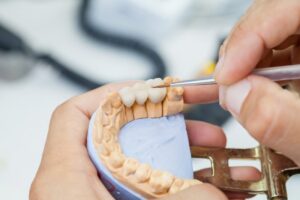
Dental crowns are commonly used to restore teeth that are damaged, weakened, or severely decayed. A crown acts like a protective cap that fits over the visible portion of a tooth, helping restore its strength, shape, and appearance. Before a crown can be placed, however, the tooth must be carefully prepared to ensure the restoration fits properly and functions comfortably.
Here’s a closer look at how dentists prepare teeth for crowns.
Examining and Preparing the Tooth
The first step is a thorough examination of the tooth and surrounding area. Your dentist will check for signs of decay, cracks, infection, or other issues that may need to be addressed before placing a crown.
X-rays may be taken to evaluate the tooth’s roots and the health of the surrounding bone. If significant decay or damage is present, the dentist will remove the affected portions of the tooth. In some cases, a patient may need a root canal before the crown procedure if the tooth’s pulp is infected.
Once the tooth is healthy and ready, the preparation process begins.
Reshaping the Tooth
To ensure the crown fits securely, the dentist must reshape the tooth by removing a small amount of enamel from all sides. This creates enough space for the crown to sit naturally among the surrounding teeth without appearing bulky.
The amount of enamel removed depends on the type of crown being used. Porcelain or ceramic crowns may require slightly more space than metal crowns in order to maintain a natural appearance.
The reshaped tooth acts as the foundation that will support the new crown.
Taking Impressions
After the tooth has been prepared, the dentist will take impressions or digital scans of your teeth. These impressions capture the exact shape and size of the prepared tooth as well as the surrounding teeth.
The impressions are then sent to a dental laboratory where the permanent crown is custom-made to match your bite and blend in with your natural smile.
Precise impressions are essential to ensure the final crown fits comfortably and functions properly.
Placing a Temporary Crown
Because it can take a couple of weeks for the permanent crown to be created, dentists typically place a temporary crown over the prepared tooth. This temporary restoration protects the tooth and helps maintain normal chewing and appearance while you wait for the final crown.
Temporary crowns are usually made from acrylic or composite material and are secured with temporary cement so they can be easily removed later.
At your follow-up appointment, the dentist removes the temporary crown and carefully places the permanent one. After checking the fit, bite, and appearance, the crown is permanently bonded to the tooth. With proper care, dental crowns can protect and strengthen teeth for many years while restoring a healthy, natural-looking smile.
About the Author
Dr. Reintjes has an impressive nearly 30 years of experience in the dental field. After attending Brigham Young University, he achieved his doctorate at the Case Western Reserve University School of Dentistry. He also completed a one-year hospital-based dental residency (emphasizing trauma care) and has undergone advanced training in orthodontics and Invisalign as well. Do you need a dental crown to repair your damaged tooth? Book online or call (559) 438-6684.